|
The Great Debate team are proud to announce our 10th year of
organising courses,
workshops and public debates for a general audience. As you can see on this
page we have had an exciting year and we still have one event to come
... we are very privileged to have Will Hutton and
Anthony Giddens in Newcastle for a lunchtime discussion on
What is radical politics today?
on 5th December.
Come along, hear the arguments and have your say!
Click here to return to 10th Anniversary page
Events for 2008

|
The Great Debate: What is radical politics today?
12.30-1.30pm, Monday, 5th December 2008
Fine Art Lecture Theatre,
Newcastle University
 Part of the Newcastle University public lecture series
Convened by Jonathan Pugh
Speakers:
Will Hutton, Chief Executive of The Work Foundation
Professor Lord Giddens, Member of the House of Lords
What is the nature of radical politics today?
How should we describe its character?
What is thought of as radical politics at this moment?
What is not? Why?
This debate is part of the What
is radical politics today? project.
The project explores the nature and character of radical
politics today, examines what it means to be engaged in
radical politics and explores how radical politics works
to shape and frame what we think of ourselves, issues and debates.
Initiated and directed by
Jonathan Pugh,
and including fifty of the worlds leading
commentators, the ongoing project is aiming to develop a sense
and feeling about the present nature and character of radical
politics. Click here for
further details.
Top of page
|
|
Authority, Respect and Human Potential in the 21st Century
7:00 – 8:30pm, Monday, 21st January 2008
Devonshire Building, Newcastle University
The Great Debate opened its 10th Anniversary celebration
with a discussion exploring the themes of authority and human
potential, examining how they are linked to the erosion of respect in
modern society.
What is meant by authority, respect and human potential today? Since the
Enlightenment the idea of the subject has had a central place in the way
that we think about ourselves. This understanding of what it is to be
human rests on the idea that we are active agents who do things for
reasons and shape the world to our own ends. Yet in recent years this
view of human nature has become deeply unpopular and we are encouraged
to think of ourselves as objects at the mercy of outside forces. At the
same time something else seems to be contributing to this historical
moment; something that has been left unexplored by many thinkers. This
is the erosion of respect for authority, reflected in modern cynicism
about politics and a deep distrust of experts. How closely connected are
these changes and how are we to understand them?
Introduced by Dr Caspar Hewett
|
|
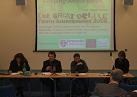
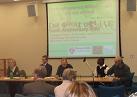
The Great Debate: Developing World Challenges
9am – 4pm, Saturday, 15th March 2008
Lindisfarne Room
King's Road Centre
Newcastle University
Location Map
Sponsored by
Economic and Social Research Council and Newcastle University
One day workshop organised by The Great Debate and
WORLDwrite.
Workshop focusing on two new documentaries made by Chew On It Productions:
I'm A Subsistence Farmer... Get Me Out Of Here! explores the
fact that whilst Westerners celebrate nature and complain about consumer
lifestyles, many in the developing world yearn for the comforts of modernity.
Keeping Africa Small examines Western NGO practices in Africa: However
well meaning they may be, NGO programmes often annoy everyone from fishermen to
shanty town inhabitants.
This challenging, exciting event examined the issues raised by the films and
provided an opportunity to learn about documentary making. In session 1 the crew
who made the documentaries shared tips on no to low budget broadcast quality
production, discussing how and why they made the films. Sessions 2 and 3 opened
with a showing of a half hour documentary followed by a debate. A panel including
one of the film makers discussed issues raised by the film and the audience
given plenty of opportunity to ask questions and make points from the floor.
Speakers
Ceri Dingle, Director of WORLDwrite
and Chew on it Productions
Viv Regan, Producer, WORLDwrite and
Chew on it Productions
Kim Tan, Campaigns Officer for
Oxfam UK
Barry K.Gills,
Professor of Global Politics, Newcastle University
John Gowing,
Reader in Agricultural Water Management, Newcastle University
Bill Colwell, Atlantic Pictures
Hilaire Agnama, Development Education Worker
Click Here for full details of event
Click here for edited video of
Keeping Africa Small debate
Click here for edited video of
I'm a Subsistence Farmer ... Get Me Out of Here! debate
Top of page
|
|
The Complexity and Change Network in association with
The Great Debate and Newcastle Philosophy Society
present
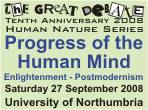
Progress of the Human Mind: From Enlightenment to Postmodernism
9am – 4.30pm, Saturday, 27th September 2008
Room D112, Ellison Building
University of Northumbria at Newcastle
 The thinkers of the Enlightenment celebrated a notion of progress
that embraced the methods of the Scientific Revolution and aspired
to improve the human condition through social advance combined with
scientific discovery. Yet by the beginning of the new millennium
the notion of progress had become associated primarily with technological
change and the worst excesses of its application in the course of the
twentieth century. What are the implications of this today and for the future?
The thinkers of the Enlightenment celebrated a notion of progress
that embraced the methods of the Scientific Revolution and aspired
to improve the human condition through social advance combined with
scientific discovery. Yet by the beginning of the new millennium
the notion of progress had become associated primarily with technological
change and the worst excesses of its application in the course of the
twentieth century. What are the implications of this today and for the future?
This one day workshop will examine the changing nature of society’s
understanding of the meaning of ‘progress’ and how it relates to the
way that humanity is perceived today. Thinkers discussed will include
Condorcet, Kant, Saint-Simon, Auguste Comte and Michel Foucault.
Introduced by Caspar Hewett and
David Large. Open to all.
NOTES
Sketch of Condorcet's Sketch
by Caspar Hewett
Henri de Saint-Simon: The Great Synthesist
by Caspar Hewett
Auguste Comte – High Priest of Positivism
by Caspar Hewett
Come along, hear the arguments and have your say
Top of page
|
|
in association with
North East Forum for Climate Change Research (NEFCC)
Tuesday, 7th October 2008
Newcastle Business School
University of Northumbria at Newcastle
Featuring:
Jim Skea,
Research Director, UK Energy Research Centre (UKERC)
Dermot
Roddy, Sir Joseph Swan Institute for Energy Research
Kate
Theobald, Sustainable Cities Research Institute
Chair:
Prof
Lynn Dobbs, Dean, School of Arts and Social Sciences, Northumbria University
In the context of both mounting anxiety over climate change and predictions that
the worldwide peak of hydrocarbon production will occur before 2021, the
North East is striving to become a global leader in the shift to a low-carbon energy
economy. Such transitions typically span decades - energy infrastructure takes years
to develop and new energy technologies are likely to take time to mature.
So, what are the prospects of seeing a widespread transition to a sustainable energy
economy? What are the barriers? What will be the main drivers of change?
How might the UK’s energy mix evolve over the next 40 years?
And what of demand management? What obligations do we have as citizen-consumers?
Come along, hear the arguments and have your say
Top of page
|
|
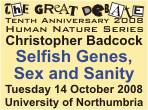
Selfish Genes, Sex, and Sanity
Sponsored by
School of Arts and Social Sciences, University of Northumbria
7 – 8.30pm, Tuesday, 14th October 2008
University of Northumbria at Newcastle
What are the connections between mental illness and genetics?
Mental illnesses like autism and schizophrenia appear to have many
different causes, some environmental and some seemingly genetic. In
this talk Christopher Badcock outlines
a new theory that seeks to
explain many of the facts in relation to conflict between genes
expressed from each parent's copy: so-called genomic imprinting. Not
only does this reveal the strange genetics involved in these illnesses
and the way environmental factors can mimic them, the new theory also
casts a revealing new light on what we take to be normality and has
far-reaching implications for our understanding of human nature.
Speaker:
Christopher Badcock, LSE
Come along, hear the arguments and have your say
This event is FREE
but BOOKING IS ESSENTIAL
Contact:

Top of page
|
|
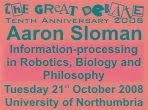
Information-processing in Robotics, Biology and Philosophy:
Unnoticed Connections
Sponsored by
School of Arts and Social Sciences, University of Northumbria
7 – 8.30pm, Tuesday, 21st October 2008
Lecture Theatre CCE1 002
Newcastle Business School
University of Northumbria at Newcastle
What can biologists, roboticists and philosophers learn from one another?
What can computer science tell us about what biological systems do and how they
do it? Is it possible to replicate or model those chemical information-processing
functions in digital electronic computing systems? What are the implications of
recent developments in computer science and software engineering in understanding
the nature of causality?
Aaron Sloman, author of Computer
Revolution in Philosophy: Philosophy, Science and Models of Mind delves
into the world of connections between ideas developed in computer science, biology
and philosophy, providing new insights into some fundamental questions about the
nature of consciousness and free will.
Speaker:
Aaron Sloman,
University of Birmingham
Chair:
Aidan
Burton, Newcastle University
Come along, hear the arguments and have your say
FREE but BOOKING ESSENTIAL
Contact:
Click here for full details
Top of page
|
|
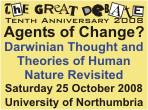
Agents of Change? Darwinian Thought and Theories of Human Nature
Sponsored by
School of Arts and Social Sciences, University of Northumbria
and
Edinburgh University Press
9am – 4pm, Saturday, 25th October 2008
Lecture Theatre CCE1-003
(Break-out Rooms: CCE1-018, CCE1-022, CCE1-021)
Newcastle Business School
University of Northumbria at Newcastle
Darwinism or Darwinitis?
Key note speech by Raymond Tallis
author The Hand: A Philosophical Enquiry into Human Being
Chair: David O'Toole,
The Great Debate
Darwinism without Darwinitis:
text of talk with slides
Click here for videos
The Great Human Nature Debate
Is there a universal human nature? If so, what do we all have in common? What makes us
different from animals? Do the defining factors even exist?
Speakers:
Rita Carter, author Mapping the Mind,
Conciousness
Caspar Hewett, Director,
The Great Debate
Thomas Pink,
author The Psychology of Freedom, Free Will: A Very Short Introduction
Chair: Kevin
Yuill, Sunderland University
Click here for videos from this debate
What can science tell us about human nature?
Can we explain the mind and consciousness in terms of brain function?
Can we understand modern human behaviour in terms of our evolutionary heritage?
Is science the right place to start if we want to understand human nature?
Speakers:
Igor Aleksander,
author The World in My Mind, How to Build a Mind
Bruce
Charlton,
author Psychiatry and the Human Condition
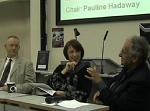
Kenan Malik, author Man, Beast and Zombie
Chair: Pauline Hadaway, Director,
Belfast Exposed
Click here for videos from this debate
Click here for full details
Top of page
|
|

Flush it!
A film première hosted by WORLDwrite & The Great Debate
Royal College of Art, London
2nd November 2008
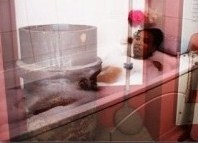
Flush it! is a documentary aiming to put aspirations for
Western levels of water provision and sanitation on the map for
developing countries. The film interweaves concerns about local
water shortages, global water scarcity and toilet history with
aspirations for grand projects and excellent loos. Eritrean refugee
Tiba is at the centre of the film. Pontificating from her own bath
full of bubbles Tiba considers everything from depleted aquifers to
desalination to Livingstone’s plea not to flush. Tiba’s wet dream
informs us pit latrines stink, while experts help flush the crap and
remind us that water can never run out.
The documentary includes witness testimony from Dr Caspar Hewett,
researcher in water resources; James Woudhuysen, Professor of Forecasting
and Innovation at De Montfort University; Angela Lee, Exhibition Curator,
Gladstone Toilet Museum; Terry Woolliscroft, Customer Manager, Twyford
Bathrooms; James Heartfield, writer and lecturer; Robin Oakley, Senior
Climate Campaigner, Greenpeace UK; Tony Rachwal, Thames Water Research
& Development Director
The film’s première will be followed by a question and answer session
with
Dr Caspar Hewett, Chair of The Great Debate and
Viv Regan, the film’s producer.
Chair:
Ceri Dingle, Director of
WORLDwrite
and Chew on it Productions
Click
here for full details of this session and the Battle of Ideas 2008
Click here
for Flush it! website
|
Top of page
|