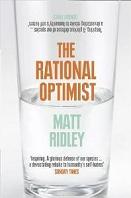
The Rational Optimist: How Prosperity Evolves
Matt Ridley turns from investigating human nature to
investigating human progress. In The Rational Optimist Ridley
offers a counterblast to the prevailing pessimism of our age, and
proves, however much we like to think to the contrary, that things are getting better.
Over 10,000 years ago there were fewer than 10 million people on the planet.
Today there are more than 6 billion, 99 per cent of whom are better fed,
better sheltered, better entertained and better protected against disease
than their Stone Age ancestors.
The availability of almost everything a person could want or need has
been going erratically upwards for 10,000 years and has rapidly
accelerated over the last 200 years: calories; vitamins; clean water;
machines; privacy; the means to travel faster than we can run, and the
ability to communicate over longer distances than we can shout. Yet,
bizarrely, however much things improve from the way they were before,
people still cling to the belief that the future will be nothing but disastrous.
In this original, optimistic book, Matt Ridley puts forward his surprisingly
simple answer to how humans progress, arguing that we progress when we
trade and we only really trade productively when we trust each other.
The Rational Optimist will do for economics what Genome
did for genomics and will show that the answer to our problems,
imagined or real, is to keep on doing what we've been doing for
10,000 years – to keep on changing.
Francis Crick: Discoverer of the Genetic Code
Francis Crick, who died at the age of eighty-eight in 2004, discovered,
together with James Watson, the structure of DNA - an achievement that
would revolutionise science and secure their place in history. In this
book Matt Ridley discusses the life of the late scientist.
Nature Via Nurture: Genes, Experience and What Makes Us Human
In February 2001 it was announced that the genome contains not 100,000 genes as
originally expected but only 30,000. This startling revision led some scientists to
conclude that there are simply not enough human genes to account for all the
different ways people behave: we must be made by nurture, not nature. Yet again
biology was to be stretched on the Procrustean bed of nature-nurture debate.
Acclaimed science writer Matt Ridley argues that the emerging truth is far more
interesting than this myth. Nurture depends on genes too, and genes need nurture.
Genes not only predetermine the broad structure of the brain, they also absorb
formative experiences, react to social cues and even run memory. They are consequences
as well as causes of the will.
Published fifty years after the discovery of the double helix of DNA,
Nature via Nurture chronicles a new revolution in our understanding of genes.
Ridley recounts the hundred years' war between the partisans of nature and nurture to
explain how this paradoxical creature, the human being, can be simultaneously free-willed
and motivated by instinct and culture. Nature via Nurture is an enthralling,
up-to-the-minute account of how genes build brains to absorb experiences.
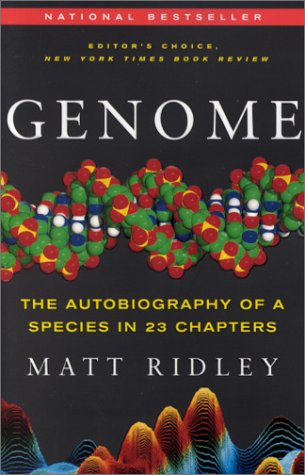
Genome: The Autobiography of a Species in 23 Chapters
In Genome, Matt Ridley examines in his inimitable style the mapping
of the human genome. He describes what the genome is, how it works, and
examines how this new knowledge will affect medicine, the pharmaceutical
industry, business, politics and our lives. Each chapter is devoted to one of
the 23 human chromosomes, telling the story of a particular gene on that
chromosome and how it affects the individual who bears it. Examining the most
important scientific achievement since the splitting of the atom, Genome
makes a useful and entertaining contribution to understanding who we humans are
and where we are going.
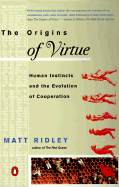
The Origins of Virtue: Human Instincts and the Evolution of Cooperation
In The Origins of Virtue Matt Ridley applies an evolutionary
perspective to explaining the roots of trust, cooperation and virtue. He argues
that humans have cooperative instincts which evolved as part of our natural
selfish behaviour; by exchanging favours our ancestors were able to benefit
themselves as well as others. Ridley shows us how breakthroughs in computer
programming, microbiology, and economics give us new insights into how and why
we relate to each other in the ways we do.
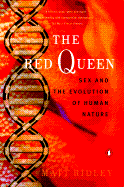
The Red Queen : Sex and the Evolution of Human Nature
In the title of this book, Matt Ridley refers to the Red Queen
from Lewis
Carroll's Through the Looking Glass, who has to keep running to stand
still; he demonstrates why sex has proved to be a successful evolutionary
strategy for outwitting ever-evolving parasites and examines the key role
played by sexual selection in human evolution.