Home | Future Events | Previous Events | People | Articles | Reviews | AboutUs
Home |
Future Events |
Previous Events |
People |
Articles |
Reviews |
AboutUs
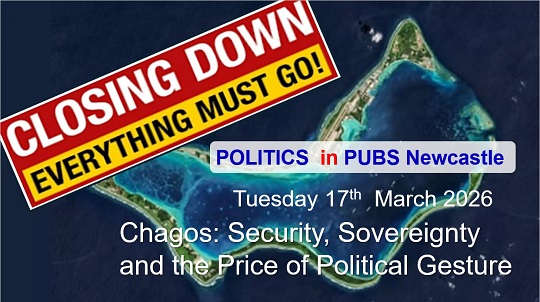
Chagos: Security, Sovereignty and the Price of Political Gesture
Introduction by Ralph Tatt
Notes from meeting held on Tuesday 17th March 2026
|
The proposed transfer of sovereignty over the Chagos Islands from the United Kingdom to Mauritius has been presented as a moral necessity and an overdue act of historical redress. But, what are the implications legally, strategically and politically? What risks does it generate for British sovereignty and constitutional integrity? |
|
March's Pips was introduced by our very own regular, Ralph Tatt, who skilfully guided us through the many intricacies of the Chagos debate.
Located in the central Indian Ocean, roughly between East Africa, India and Southeast Asia, in a region busy with maritime trade, the Chagos Archipelago is one of the most strategically significant locations on the planet.
Uninhabited until the late 18th century, the islands were settled during the colonial period and have since been bound up in wider geopolitical developments, from empire to the Cold War.
In 1814, the islands, along with Mauritius, from which they were administered, were ceded by France to the United Kingdom. In 1965, Mauritius was separated from the administration and the territory was established as the British Indian Ocean Territory, enabling the United States to establish a military base on Diego Garcia.
Although the land area amounts to only a few dozen square miles, the widely dispersed islands are associated with a vast Exclusive Economic Zone. Mauritius gained independence in 1968, retaining certain fishing rights in the surrounding waters.
By 1973, the permanent inhabitants—the Chagossians, a population established during the plantation era, had left the islands, many having been forcibly removed.
The current controversy over sovereignty is more recent. The United Nations, through the International Court of Justice (ICJ), has increasingly taken an interest in post-colonial disputes, and in 2019, the ICJ issued an advisory opinion finding that the separation of the Chagos Islands from Mauritius was unlawful.
Much of the ensuing discussion focused on the wider geopolitical context, including the UK’s position, the United States' security interests, and the broader implications of the proposed transfer of sovereignty. Questions were raised about the role of international institutions, including the appointment of ICJ judges, the court’s accountability, and the weight to be given to advisory opinions in matters of national security.
It was noted that the historical administration of Chagos from Mauritius may reflect colonial-era arrangements, and that geographically, the Maldives lie closer to the archipelago. Central to the discussion was the question of self-determination for the Chagossian people, an exiled population now numbering several thousand, many of whom hold British citizenship.
At the same time, the growing geopolitical importance of the Indo-Pacific region was emphasised, particularly amid evolving global security dynamics.
Questions were also raised about the broader implications of the ICJ’s position. If advisory opinions in such cases carry increasing weight, what might this mean for other British Overseas Territories such as Gibraltar or the Falkland Islands? The status of the UK’s sovereign base areas in Cyprus was also discussed.
A widely held view in the room was that, while the ICJ carries significant moral and legal influence, it lacks direct democratic accountability and enforcement power.
The discussion concluded with a broader question: what if the Chagossians themselves were granted sovereignty and allowed to determine the future of the islands?
Martin Evison, 2026
More information about Politics in Pubs can be found here: politicsinpubs.org.uk
More information about previous and future events can be found at POLITICS in PUBS Newcastle Homepage
If you find this interesting, consider joining
The Great Debate
facebook group or
visit The Great Debate facebook page.
Follow us on Twitter:
@greatdebateuk
Home | Future Events | Previous Events | People | Articles | Reviews | AboutUs
© C J M Hewett, 2026