Home | Future Events | Previous Events | People | Articles | Reviews | AboutUs
Home |
Future Events |
Previous Events |
People |
Articles |
Reviews |
AboutUs
Public Health Approaches in Policing
Notes from meeting held on Tuesday 3rd February 2026
|
Policing is no longer only about responding to crime after it happens. This raises difficult questions. What does prevention mean if no crime has been committed? How does acting in advance of a crime actually happening sit with ideas like fairness, free speech, and being innocent unless proven guilty? |
|
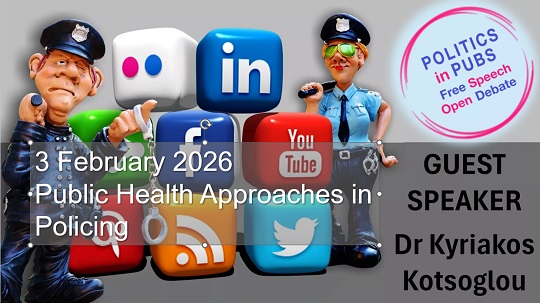
February's Newcastle PiPs was introduced by Dr Kyriakos Kotsoglou, Associate Professor in Law at Northumbria University.
Kyri has an academic interest in the use of "Non-Crime Hate Incidents" (NCHIs) - a topic he first introduced to PiPs Newcastle in December 2023 (read the write-up here). He referred to their ultimate origins as part of a broader College of Policing initiative derived from the World Health Organisation (WHO) "Vision 2025" programme intended to take a Public Health approach to crime, reflected in the growing role of police as social workers.
There are a number of flaws to this approach. It fails to reflect one of the most basic principles of policing, that crime is non-random and it is often a small section of society that is responsible for the vast majority of crimes. Policing becomes a logistical nightmare, as it opens the scope of crime endlessly. Anyone could claim to have suffered offence on the basis of some characteristic and it is impossible to foresee every possible source of offensive behaviour. The distinctions between harmful and unlawful are blurred.
Although crime prevention sounds laudable, the public health route raises another endless chain of causes, causes of causes, and causes of the causes of causes.
The risks of authoritarianism are already evident. There seems to be a dilution of due process. Proposals to reduce the number of police forces from 43 to 12 raises further possibilities of authoritarian centralised control of originally local policing.
As usual, there was wide-ranging discussion! Relationships beween crime and health, public good versus individual liberty, and risks versus benefits are poorly thought out. Underlying subjectivity means criteria for intervention are ill-defined and open to perverse outcomes, as appear evident surrounding the transgenderism and Gaza protests, where differences in accountability seem stark.
The social media use of AI seems to raise a whole new spectrum of potentially offensive behaviour.
The unpredictable and arbitrary nature of this situation leaves the ordinary citizen exposed to "double bind" situations, where any action or, possibly, inaction may be perceived as harmful.
Martin Evison, 2026
More information about Politics in Pubs can be found here: politicsinpubs.org.uk
More information about previous and future events can be found at POLITICS in PUBS Newcastle Homepage
If you find this interesting, consider joining
The Great Debate
facebook group or
visit The Great Debate facebook page.
Follow us on Twitter:
@greatdebateuk
Home | Future Events | Previous Events | People | Articles | Reviews | AboutUs
© C J M Hewett, 2026